SPICE Module
Device-level switching detail inside the SIMBA workflow.
The SIMBA SPICE Module lets teams move from fast system-level studies to detailed semiconductor behavior without rebuilding the circuit in a separate tool. Use ideal switches for exploration, then bring vendor SPICE models into the same simulation environment when gate-drive, parasitic, and transient effects matter.
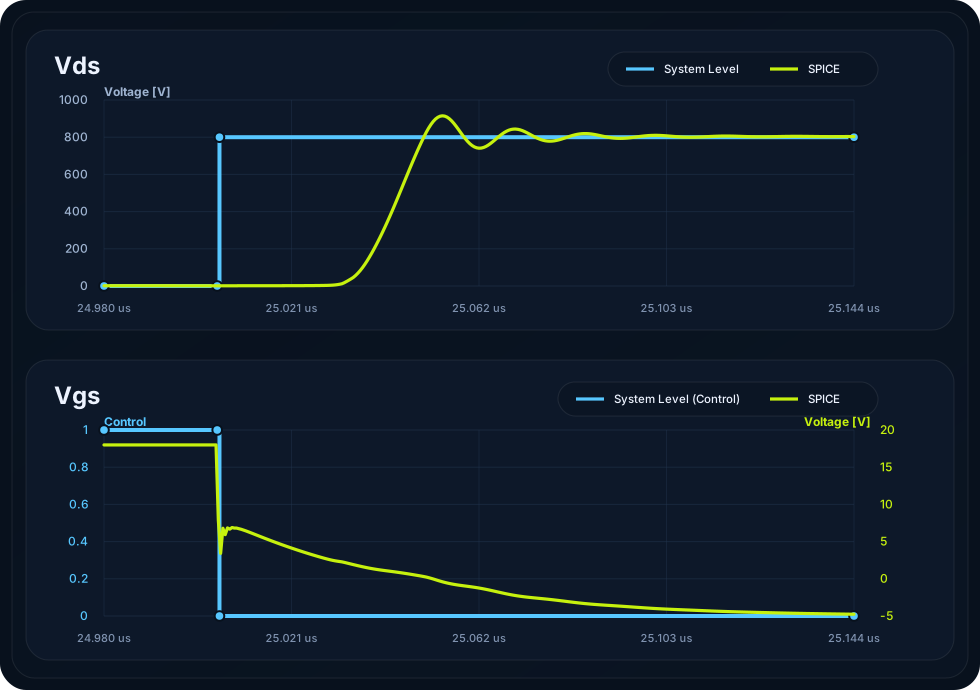
One model path from architecture to switching detail
Power electronics teams often maintain separate system and SPICE projects. The SPICE Module keeps the design workflow unified so engineers can increase model fidelity only where the study requires it.
Run system-level and SPICE-level simulations in the same SIMBA project, with the same solver and the same analysis workflow.
Import native SPICE netlists to study non-linear capacitances, gate resistance, switching transients, and detailed device behavior.
Generate custom loss data under Zero-Voltage Switching operation for topologies such as LLC and Dual Active Bridge converters.
Combine switching-scale electrical detail with longer thermal time horizons using Dual Stage Electro-Thermal Simulation.
Designed for SiC and GaN switching studies
Wide-bandgap devices make switching dynamics, parasitics, and gate-drive behavior harder to ignore.
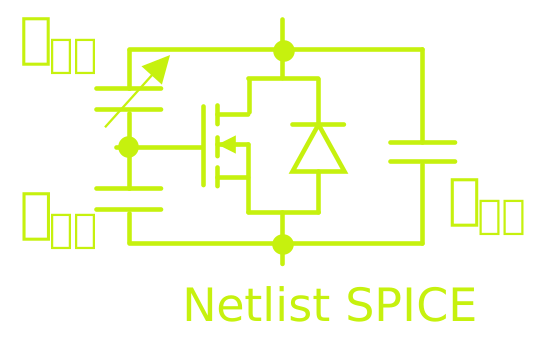
Place detailed vendor models directly into the system simulation where device physics are needed.
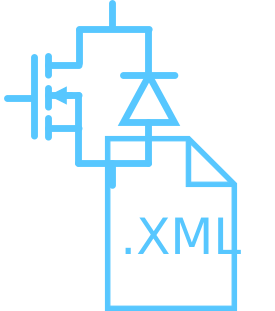
Keep fast ideal-switch models for architecture exploration, efficiency maps, and large sweeps.
From SPICE transients to thermal decisions
The SPICE Module is useful when standard datasheet loss data is not enough, especially for high-frequency converters, ZVS operating modes, gate-driver studies, and switching-event validation.
Detailed device simulations can feed custom thermal descriptions so the same design can return to fast system-level studies with more accurate loss assumptions.
Add detailed SPICE simulation when the design requires it
Use the SPICE Module alongside SIMBA Desktop and the Python Library to move between interactive design, automated campaigns, and device-level validation.
- Native SPICE netlist support for detailed semiconductor models
- System-level and device-level simulation in one environment
- Custom loss-data workflows for ZVS and other operating modes
- Useful for gate-drive, parasitic, EMI-oriented, and electrothermal studies